If you’ve ever tried to look up a court case, track down a property owner, or find a marriage certificate, you’ve probably run into the same frustrating wall: there’s no single place to search. These records are commonly used for background checks, property research, legal verification, and investigative purposes — yet finding them requires knowing where to look. That’s because public records in the United States aren’t stored in one central database. They’re spread across thousands of agencies at three distinct levels of government — federal, state, and county. Understanding how that system is organized is the single most useful thing you can do before starting any public records search.
Quick Answer
Public records in the United States are organized across three levels of government:
- Federal — handles bankruptcy, federal court cases, immigration, and national-level records
- State — manages vital records, statewide court systems, and professional licensing databases
- County — maintains property records, local court filings, and most day-to-day records
There is no single database. You must identify the correct level of government and the correct agency before you can search effectively.
⚠️ Availability, access methods, and fees vary significantly by jurisdiction.
Why There Is No Central Database
The United States operates on a principle of federalism, meaning government authority is divided between the federal government and the states. Each state in turn delegates much of its record-keeping responsibility to counties, cities, and municipalities. The result is a decentralized system where the same type of record — say, a property deed or a court filing — might be stored differently depending on which state, county, or city you’re searching in.
This isn’t a flaw in the system — it’s a direct result of how government authority is structured in the United States. Local governments are closer to the people they serve and better positioned to maintain records relevant to their jurisdiction. But it does mean that knowing where to look is just as important as knowing what you’re looking for.
How the System Is Structured
Think of public records as a layered system, moving from broad national matters down to local day-to-day records:
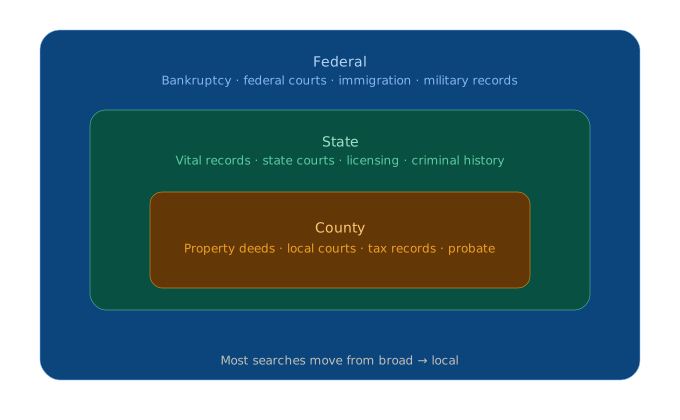
FEDERAL
└── National-level matters: bankruptcy, federal courts, immigration, military

    STATE
    └── Statewide systems: vital records, state courts, licensing, criminal history

        COUNTY
        └── Local records: property deeds, probate, local court filings, tax records
Most searches move from broad to local depending on the record type. A federal bankruptcy case stays at the federal level. A property deed search almost always ends at the county recorder’s office. A marriage certificate could be state, county, or both — depending on where you are.
Federal Records
Federal records are created and maintained by agencies of the U.S. federal government. These cover matters that fall under federal jurisdiction — things like bankruptcy cases, federal criminal proceedings, immigration records, military service records, and certain regulatory filings.
The most widely used federal public records system is PACER (Public Access to Court Electronic Records), which provides access to federal court filings including bankruptcy, civil, and criminal cases at the district and appellate level. Other federal records are managed by agencies like the National Archives, the Social Security Administration, and the Department of Veterans Affairs.
Federal records are accessed through the specific agency that created them. The Freedom of Information Act (FOIA) gives the public the right to request records from federal agencies, though some records are exempt from disclosure for privacy or national security reasons.
Common federal record types:
- Federal court cases (via PACER)
- Bankruptcy filings
- Military service and discharge records
- Federal land and patent records
- SEC filings and corporate disclosures
State Records
State-level records cover matters governed by state law. This includes vital records like birth, death, marriage, and divorce certificates, as well as state court cases, professional license verifications, and statewide criminal history databases.
Each state manages its own systems, which means access rules, fees, and search tools vary significantly from one state to the next. Some states have robust online portals that let you search court records for free. Others require written requests or in-person visits to access the same information.
State vital records are typically managed by a Department of Health or Office of Vital Statistics. State court records are usually handled by the Administrative Office of the Courts or a similar agency. Criminal history records are often maintained by the state’s Bureau of Investigation or Department of Public Safety.
Common state record types:
- Birth, death, marriage, and divorce certificates
- State court filings (civil and criminal)
- Statewide criminal history and sex offender registries
- Professional and business licenses
- Voter registration records (where publicly available)
County Records
County-level records are where most everyday public records searches end up. Property records, deed transfers, probate filings, local court cases, and tax assessments are almost always maintained at the county level. In states without counties, equivalent functions are handled by parishes (Louisiana) or boroughs (Alaska).
The county recorder or register of deeds handles property transactions. The county assessor maintains tax and valuation records. The county clerk handles court filings, election records, and often vital records as well. In larger counties, these offices may have online search portals. In smaller or more rural counties, you may need to call or visit in person.
Because there are over 3,000 counties in the United States, this is where public records searches get the most fragmented. A property that sits on a county line, or a person who has lived in multiple counties, can require searching several different systems.
Common county record types:
- Property deeds and transfer records
- Tax assessments and parcel data
- Probate and estate filings
- Local civil and criminal court cases
- Marriage licenses (in many states)
- Building permits and zoning records
How to Use This When Searching
Before starting any public records search, identify which level of government is responsible for the record you need — then go directly to that source.
| Record Type | Level | Where to Start |
|---|---|---|
| Federal court case | Federal | PACER (pacer.uscourts.gov) |
| Bankruptcy filing | Federal | PACER |
| Property deed or ownership | County | County recorder or assessor |
| Tax assessment or parcel data | County | County assessor’s office |
| Marriage or divorce certificate | State / County | State vital records office |
| State criminal case | State / County | State court portal |
| Professional license | State | State licensing board |
| Military service record | Federal | National Archives (archives.gov) |
If you’re not sure where to begin, start with a general search guide:
- → How to Investigate Someone Using Public Records
- → How to Check Court Records
- → How to Search Property Records
- → How to Find Criminal Records
- → How to Search Public Records by State
These guides walk through the exact process step by step, including which agency to contact and how to access records online where available.
Common Mistake
The most common mistake in public records research is starting with the wrong level of government.
Searching for a property record at the state level, or looking for a federal case in a county system, will lead to incomplete or misleading results. Identifying the correct jurisdiction first is what determines whether a search succeeds.
The Bottom Line
Public records are accessible — but not centralized. Every search depends on identifying the correct jurisdiction and agency before attempting to locate the record.
Once you understand how federal, state, and county systems interact, the process becomes predictable: identify the record type, locate the responsible office, and access the official repository directly.
The guides on this site are built around exactly that logic. Each one walks you through the right jurisdiction, the right office, and the right search method for a specific record type — so you spend less time guessing and more time finding.
Start with the guides below to locate the correct agency and access records directly through official sources.
PublicRecordResources.com is an educational resource. We are not a government agency and do not provide consumer reports or background check services.